
Business
BEIJING: Will Apple be the last US tech giant left in China?


BEIJING: There was a time when the US tech giants were all in China – even Facebook. Today, Apple’s huge presence in the country looks increasingly conspicuous.
Last week Microsoft, which still operates in China, announced it was to shut down its social network, LinkedIn, there.
The company said having to comply with the Chinese state had become increasingly challenging – so it pulled the plug.
Apple has its own censorship problems in the country.
The BBC reported last week that two popular religious apps had been removed from Apple’s App Store.
It later emerged that Amazon-owned Audible and the Yahoo Finance app had also been taken down.
Apple Censorship, a group that monitors the App Store, says it has seen an increase in apps that have been removed this month.
So what is going on?
The great tech crackdown
It is notoriously hard to gauge what’s happening behind closed doors in Beijing.
Still, what is becoming increasingly clear is that Apple and Microsoft are embroiled in a domestic battle between the authorities and the Chinese tech industry.
China has its own big tech titans – Tencent, Alibaba and Huawei – that are enormous global companies. But the Chinese government has grown worried about the power they wield.
- In April, Alibaba accepted a record $2.8bn (£2bn) fine after an investigation found that it had abused its dominant market position
- In August, the Chinese government unveiled a five-year plan outlining tighter regulation of the tech economy
- It’s also been cracking down on Bitcoin
American companies haven’t been spared from the “great tech crackdown”.
“The crackdown suggests that both Apple and Microsoft are very aware that their position is more tenuous than it’s been in recent years. They know they need to walk carefully,” says James Griffiths, author of The Great Firewall of China.
The straw that broke the camel’s back for Microsoft appears to be a law due to come into force on 1 November – the Personal Information Protection Law (PIPL) – which would have required the company to comply with more regulation.
Microsoft alludes to it in a statement explaining its decision to pull LinkedIn: “We’re facing a significantly more challenging operating environment and greater compliance requirements in China.”
Graham Webster, editor-in-chief of the DigiChina Project at Stanford University, said: “I think they decided it just wasn’t worth it.”
Mr Webster links the decision to say goodbye to LinkedIn to forthcoming enforcement of the PIPL.
The devil’s bargain
Apple, however, has a different set of priorities in China to Microsoft.
It is deeply entangled in the country, far more so than any other US tech company.
In the last quarter, Apple made nearly $15bn in revenue in China and Taiwan – an extraordinary figure.
Its global supply chain also depends on Chinese manufacturing. And to be in China, Apple knows it has to play by the country’s rules – even if that means censorship.
You might ask: why doesn’t Apple just sell hardware in China, and forget about the App Store?
The problem is, Apple believes the App Store and the iPhone are inseparable. It doesn’t want to set a precedent of side-loading apps, where people can download apps on an iPhone away from the App Store.
For one thing, it would make considerably less money.
So if Apple is going to sell products in China, keeping the App Store operational in that country is deemed essential.
“Apple has been removing apps and essentially censoring the App Store in one way or another for years,” Mr Webster says.
But Mr Griffiths argues that censorship has slowly grown stricter during Apple’s time in the country.
“Apple has set itself a devil’s bargain here,” he says.
“Once you start to agree to remove apps, it doesn’t really stop.”
Secret strategies
Other companies saw the writing on the wall earlier than Microsoft.
Google removed its search engine from China in 2010, after what it said was a Chinese hacking attack. The company said it was no longer happy to censor searches.
Rebecca Fannin, author of Silicon Dragons, believes Microsoft’s pulling of LinkedIn now makes Apple a “big target”.
But she thinks Apple is going to fight to stay in China.
“You know Apple is really one of the market leaders in China… I don’t see Apple pulling out of China over any of these issues any time soon,” she says.
What we don’t know are the conversations that are going on behind closed doors between Apple and the Chinese authorities.
Perhaps Apple does push back, and maybe many apps are still up and live on the App Store in China because Apple stood up for them. We don’t know.
Apple rarely comments on these stories, and points journalists to its human rights policy, which states it will follow the laws of the countries it operates in – even if it disagrees with them.
And in China, they’ve been doing just that.
When the authorities really want an app taken down, it gets removed.
Apple’s presence in the country now feels almost like a hangover from another era. Big Tech simply doesn’t have much of a presence in China any more.
The question now is how much regulation, how much compliance – and how much censorship – is too much?











NEW YORK: Union Minister of Commerce and Industry, Piyush Goyal, declared that the H1B visa issue is now “a thing of the past” during a meeting at Vanijya Bhavan, New Delhi.
He emphasized that the topic would no longer be a point of discussion in international dialogues, marking a shift in focus towards other areas of economic and strategic partnerships.
Minister Goyal’s recent visit to the United States included a two-day stay in New York, where he met with CEOs of major companies to discuss reforms initiated by the Modi government aimed at boosting foreign investments in India, particularly in the pharmaceutical and diamond sectors.
Surat, a prominent hub for the diamond industry, was highlighted as a key region for such investments. Goyal met around thirty business leaders who have already established ventures in India, signalling continued interest in expanding business operations in the country.
Following his engagements in New York, the Minister travelled to Washington, where he had a luncheon meeting with 17 CEOs from the CEO forum, including Tata Sons’ top executive.
The discussions primarily centred on restructuring the forum, as the terms of several members are set to expire in December. Various Memorandums of Understanding (MoUs) were also signed during the visit, underscoring the commitment to deepening business ties.
The visit also involved meetings with Small and Medium-sized Enterprises (SMEs), think tanks, educators, and the Center for Strategic and International Studies (CSIS). Goyal described this visit as different from previous trips, noting that there were no “negative agendas” on the table, reflecting a more positive outlook towards Indo-US relations.
Discussions extended beyond traditional sectors, covering potential partnerships in critical areas such as clean energy development, technology transfer, digital telecommunications, and defence.
Talks on biosciences have been ongoing, though Goyal noted that progress on biofuels was limited due to the upcoming US elections.
There were also conversations about setting a stable exchange rate between the Indian rupee and the US dollar, which could benefit bilateral trade.
Tourism and the development of the digital economy were also focal points during his meetings. Goyal’s engagements at the CEO forum and with the CA forum aimed to showcase India’s evolving business landscape and ongoing economic reforms, positioning the country as an attractive destination for global investment.
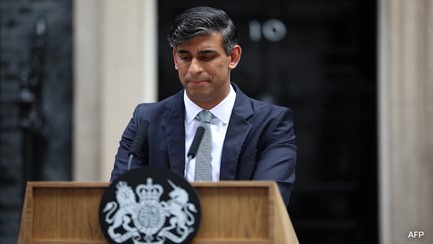
LONDON: The two frontrunners in the race to replace Rishi Sunak as Conservative Party leader and take his place in the House of Commons as Leader of the Opposition have thrown the spotlight on cutting immigration into the UK, with visas for Indians being singled out in heated debates.
Against the backdrop of the launch of the Conservative Party conference in Birmingham on Sunday, former immigration minister Robert Jenrick singled out India as one of the countries that should be subjected to tough visa restrictions across all categories unless it takes back its nationals who enter Britain illegally.
His closest contender, shadow housing secretary Kemi Badenoch, has also zeroed in on the same issue and condemned new migrants bringing their disputes from India to cause unrest on the streets of the country.
“It is quite clear that there are many people who have recently come to this country who have brought views from their countries of origin that have no place here,” Badenoch told the BBC.
“I saw as equalities minister people bringing cultural disputes from India to the streets of Leicester… we need to make sure that when people come to this country, they leave their previous differences behind. This is not a controversial thing to say,” she said.
Nigerian-heritage Badenoch, considered among the favourites to win the ongoing Tory leadership election, was apparently referencing the clashes that broke out in Leicester in September 2022 in the wake of an India-Pakistan Asia Cup cricket match.
Meanwhile, her former ministerial colleague Robert Jenrick who has notched up an early lead in the contest told ‘The Daily Telegraph’ earlier this week that while India benefited from 250,000 visas in the past year, there were as many as 100,000 Indian nationals estimated to be illegally residing in the UK.
He lamented that deportations or removals to India remain stuck in the hundreds despite an India-UK Migration and Mobility Partnership which is designed to cover such returns of illegal migrants.
“The government must stop other countries exploiting our generosity by imposing severe visa restrictions and restricting foreign aid to countries that do not take back their nationals here illegally,” said Jenrick.
Over the four-day Tory conference starting on Sunday, Jenrick and Badenoch will go head-to-head with two other party colleagues – former Cabinet ministers James Cleverly and Tom Tugendhat – as they make their leadership pitches before MPs vote in the next round. This time the field will be whittled down to the final two candidates who will then fight it out for the online ballot of the wider Conservative Party membership, many of whom will be making up their minds during the party conference. The new Conservative Party chief and Opposition Leader is then scheduled to be declared on November 2 after the voting closes.
The election follows the resignation of Sunak as Tory leader in the wake of the party’s bruising general election defeat in July under his leadership. The British Indian politician, who was re-elected member of Parliament from Richmond and Northallerton in northern England, has meanwhile been serving as interim leader until his successor is elected.

ATHENS: Greece has witnessed a remarkable 37 per cent surge in property purchases by Indian investors between July and August. This flurry of activity is driven by Indian buyers eager to secure permanent residency under Greece’s Golden Visa Programme before significant regulatory changes took effect on September 1.
Launched in 2013, Greece’s Golden Visa programme offers residency permits in exchange for property investments, making it an attractive option for non-EU citizens. Its initial €250,000 (Rs 2.2 crore) threshold was one of Europe’s lowest, drawing significant investment and boosting Greece’s real estate market.
However, the surge in demand pushed up property prices, particularly in high-demand areas like Athens, Thessaloniki, Mykonos and Santorini. To address this, the Greek government raised the investment threshold to €800,000 (approx Rs 7 crore) for properties in these regions, effective September 1 2024.
Sanjay Sachdev, Global Marketing Director of Leptos Estates, noted an “unprecedented rush” of Indian homebuyers in recent months. “Many investors purchased under-construction projects with handover periods of six-twelve months,” said Sanjay Sachdev, as per MoneyControl.
Many invested in properties under construction, with completion timelines of six to twelve months. Leptos Estates reported selling out its available residential stock in Greece due to this surge.
Effective September 2024, the revised Golden Visa programme seeks to:
– Temper rapid price increases
– Promote equitable development
– Direct investment towards less saturated areas
The appeal of Greece’s Golden Visa Programme for Indian investors
– Greece offers attractive rental yields of 3-5 per cent annually, making property investments financially rewarding.
– Property values in Greece have been increasing at an impressive rate of 10 per cent year-on-year, with significant growth following the pandemic.
– Investors gain access to high-quality healthcare, education, and the opportunity to establish businesses within the EU.
Before the rule changes, Indian investors gravitated towards popular Greek islands like Paros, Crete, and Santorini for property purchases.


MELBOURNE: Fourth India-Australia 2+2 Secretary-level Consultations

TORONTO: India’s response to diplomatic communication from Canada

NGERULMUD: Shri Harsh Kumar Jain concurrently accredited as the next Ambassador of India to the Republic of Palau

STOCKHOLM: Dr. Neena Malhotra appointed as the next Ambassador of India to the Kingdom of Sweden
2020 will be remembered as time of the pandemic. The fallout will be felt for years

KINGSTON: Shri Subhash Prasad Gupta concurrently accredited as the next High Commissioner of India to St.Vincent and the Grenadines
-
 Diplomatic News2 years ago
STOCKHOLM: Dr. Neena Malhotra appointed as the next Ambassador of India to the Kingdom of Sweden
-
Opinions5 years ago
2020 will be remembered as time of the pandemic. The fallout will be felt for years
-
 Diplomatic News2 years ago
KINGSTON: Shri Subhash Prasad Gupta concurrently accredited as the next High Commissioner of India to St.Vincent and the Grenadines
-

 Politcs2 years ago
LONDON: Indian-Origin Candidate On How He Plans To Win London Mayoral Polls
-

 Technology2 years ago
MARYLAND: All About Pavan Davuluri, New Head Of Microsoft Windows
-

 Sports2 years ago
DODOMA: Milind Soman At “Friendship” Marathon Organised By India, Tanzania
-

 Business2 years ago
LONDON: UK Court Allows Sale Of Nirav Modi’s Luxury London Apartment
-

 Science2 years ago
WASHINGTON: Who Is Aroh Barjatya, Indian-Origin Researcher Who Led Recent NASA Mission